≡ Menu

An exhausting day yesterday, full of birds and bugs on only the first mile of Pipeline Road. The coolest life bird was a White-whiskered Puffbird sitting, still-life, by the side of the road. Like all other puffbirds I’ve ever seen, it didn’t move more than an inch. Kingfisher took this photo with his point-and-shoot:

Wwpuffbird

Other memorable moments:

  • Watching a female Fasciated Antshrike a few yards away seemingly trying to pick up a 6-inch branch. It turned out to be an enormous grasshopper. She’s still digesting.
  • Finding three army ant swarms and their attending birds. I was studying where Sam Britton, our guide, was trying to get me on a Chestnut-backed Antbird, and instead saw a gray- and pigeon-headed fat bird with yellow legs strolling by — Little Tinamou. A bird most often heard than seen, and less common than Great Tinamou.
  • Watching one of many Bicolored Antbirds hunt in an ant swarm right at our feet, intent on finding lunch. Amazing.
  • Seeing at least four species of crackers, noise-making Neotropical butterflies I’ve written about before, one of which landed on my leg.
  • Sam taking to a location where he found a jaguar track in the mud, which was still recognizable as one big cat print.
  • Last lifer of the day, a gorgeous Green-and-rufous Kingfisher at Summit Ponds.
  • Hiking up to the new Pipeline Road visitors center (below) which is opening later this month. It’s about 2 km from the first gate at the beginning of the road, near the first stream crossing (Juan Grande).
Pipelineroadthing_2

We are picking up our rental car today, and I think we’re going back to Pipeline. More later.

Filed in Travel

panama: day 1

After an entire uneventful but tedious travel day on Saturday, we spent today in Panama City today, putzing around a favorite place, the Metropolitan Nature Park. This is nearly 700 acres of lowland tropical forest, and the only tropical forest park in a major city in Latin America.  We had nearly 50 species of birds, most of which we’d seen before. I had three life birds: Southern Bentbill, Boat-billed Flycatcher, and Green Honeycreeper. We had great looks at the bentbill, which does have a crazy-looking bill in “person.”

We were just as preoccupied with the insects. Although not as plentiful as in the wet season, we still had fun creeping up on small butterflies, damselflies, and just flies. We did not have the abundance of hover flies down here when we were here in August 2005. This is the start of the dry season here, and just as we have more of some species of bee flies in the early spring, they were also very noticable here. You’ll recall I’m pretty fond of photographing flies. So I was happy to get a decent shot of this one when it perched:

Panamahoverfly

There were many hovering in patches of sunlight in the forest. I use my left eye in the viewfinder of the camera, and that’s the eye that is still not 20/20. It took me awhile to remember to use my right eye, or trust the camera to autofocus.

We found a lot of butterflies, as usual, and the variety of very similar-looking satyrs here is almost discouraging. I think we’re pretty close in identifying this one as a Gold-stained Satyr (Cissia pseudoconfusa), although I am genuinely confused, not pseudo-confused, by most of them.

Goldsatyr

Tomorrow we have a full day at Pipeline Road, which starts near the Canal in Gamboa and snakes into Soberania National Park. We had a great time and quite an adventure (involving a thunderstorm, broken-down vehicle, rescue, re-stranding on the wrong side of a large fallen tree, machetes, and a side trip to a Smithsonian lab) last time we were there. We’re really looking forward to having a long walk doing whatever we please all day long there.

Filed in Travel

the year in birds: 2007

I did this for 2005 and 2006, and it's easier than making New Year's resolutions.

  • Number of species seen: I generally only keep local year lists, and in 2007 only kept up with a year list for my home city. I had 156 species, which is 8 better than the year I tried to do a city "big year."
  • New life birds: 3, all close to home. Purple Sandpiper, Black-backed Woodpecker, and Hoary Redpoll.
  • Total life birds: 911
  • Total ABA-area birds: 571
  • Total state birds: 308
  • Total birds in my home county: 251
  • Total birds in my home city: 213 (I added five species this year)
  • Total birds at my place of work: 186 (three new ones)
  •  Yard birds: 134. Two came just recently. Number 133 was a Northern Saw-whet Owl and 134 was a Northern Shrike.

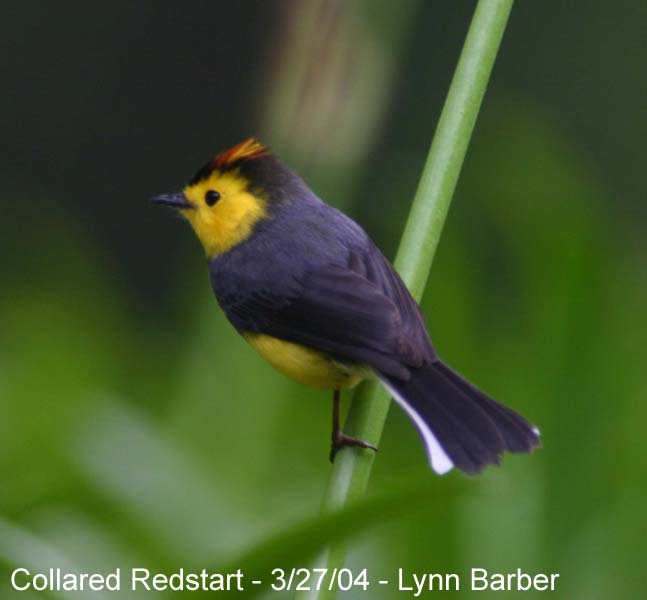
 I anticipate that my next life bird will be found in four days, at the Metropolitan Nature Park in Panama City, Panama. We leave on Saturday, and I can sure use the getaway even though I am a bit anxious that this isn't such a good time to go. Last time I was there, I summarized the best birds of each day, and perhaps I'll do the same this time. The new birds I'm most looking forward to seeing will be in the highlands portion of our trip. They include Long-tailed Silky-Flycatcher, Resplendent Quetzal, Red-headed Barbet, Slate-throated Redstart, and Collared Redstart.

As always, I wish you new birds — or other fabulous new experiences — in the New Year!

Filed in Flotsam and jetsam

deer browsing and songbirds

The latest issue of the Ibis, the journal of the British Ornithologists’ Union, had several excellent papers. One was an overview of the impacts that deer browse has on habitat quality and subsequently bird life. I would like to highlight some salient points, because they illustrate the interconnectedness of ecosystems, and can serve to help the average person understand that too many deer don’t just mean fewer wildflowers in the woods.

We’ll start with that simple point. Deer browsing changes under- and mid-story vegetation not only by changing the species composition (skewing it towards unpalatable species) but by reducing the abundance and density of trees, shrubs, and vines. For birds, this can mean a loss in available nest sites and roost sites, and an increased vulnerability to nest predation. This seems fairly intuitive. The impacts of deer browse on the food supply of birds is often less direct.

Deer prefer to eat growing shoots of plants, which not only affects the growth of the plant, but may also delay or prevent flowering. This can reduce the number of pollen-seeking insects on which birds may feed during the breeding season. No flowers means no fruits or seeds, which birds consume later in the season, often fueling migratory flights or providing winter forage. Of course, deer also eat fruit and seeds, putting them in direct competition with birds.

Many insects, such as lepidoptera larvae which are so important to birds feeding nestlings, also prefer to feed on actively growing plant tissue just as the deer do. This paper notes a number of studies have found that these invertebrates can be reduced by deer browse in the vegetation layers that can be reached by deer.

Leaf litter thickness often also changes in forests with high densities of deer. Their browsing can alter the amount of sunlight that reaches the forest floor, and decreased density of trees and shrubs, as well as direct grazing on herbaceous plants, often coincides with more grasses or bare ground. This can all result in reduced number of some types of leaf litter invertebrates that are important to ground foraging bird species.

The New York Times just had a short article on the stupendous increase in White-tailed Deer in the United States — doubling in population the last twenty years to an estimated 32 million animals. That’s 12 million more than were here prior to European settlement, in far less space. The Times graphic shows that here in Michigan, I have a 1 in 86 chance of hitting a deer with my car in the next year, the second-highest odds in the nation.

The Ibis paper (and indeed the entire issue) is available for free at the journal home page.

Gill, R. M. A. and R. J. Fuller. The effects of deer browsing on woodland structure and songbirds in lowland Britain. Ibis 149:119-127. doi:10.1111/j.1474-919X.2007.00731.x

Here are some links to previous posts I’ve done that included the impact of deer overpopulation:

Filed in Environmental issues

Our newest yard bird (#133) was a very sleepy Northern Saw-whet Owl, roosting in one of our cedar trees, right outside our kitchen window. Although it wasn’t deeply concealed, we never would have noticed it if my husband hadn’t seen the big blop of whitewash under the tree. He looked up, and there it was. Not a great photo below, because the bird has its head turned and eyes closed.

Nswo1yard A few years ago, we found a pellet under one of our other cedar trees that looked like it belonged to a saw-whet, so we’ve always half expected to find one here one day. This would be the obvious year. Following on the tail-feathers of this year’s boreal finch invasion, it has now been predicted northern owls will also be making a strong showing; already many banding stations have caught record numbers of migrating saw-whets.

With the arrival of winter and what may be many owls far south of their normal range, perhaps it’s time to review a little owl etiquette (applicable to all birds and other wildlife).

You might recall the Snowy Owl that showed up near here last winter. I ended up writing about how people cannot seem to use good judgement and behavior when it comes to owls. When I reminded people on the local bird list to be respectful of the owl, people commented on how healthy it seemed to be, and one photographer even commented that his observations led him to believe the owl was “in good health and exploring its surroundings or playing, if one likes.”

Snow3benchIn early spring when the snow melted, the owl was found dead right near the last location it was seen alive. The carcass was brought to me. I gave it a cursory exam, and could see that there was no subcutaneous fat. Even taking into consideration some dehydration from freezing, it was obvious the bird was extremely lean. I gave the owl to the state for a necropsy. As it turned out, the owl had died of malnutrition. There were some miscellaneous contusions (which may have occurred post mortem) and feather lice, but the cause of death of this healthy-appearing owl was malnourishment.

The winter energy budgets of birds must be managed very carefully. Every time an owl is flushed, or even if it needs to remain awake and vigilant due to activity around it, precious energy may be wasted. This Snowy Owl was an example of a bird that dozens of people perceived to be healthy and “happy,” even as it was slowly starving to death.
.

Filed in Birds

Real or fake?  Every year, folks try to decide whether to get a live Christmas tree, or put up an artificial tree.  This topic has been fairly well covered on several green blogs, so I will offer an overview and resources.

Umbra at The Grist sums up the verdict on artificial trees:  They are made mostly of PVC (sometimes stabilized with lead), a product that is essentially toxic from cradle to grave.  And they are likely made overseas, probably in China. Triple Pundit actually did the math on which type of tree — real or fake — was more carbon-neutral. Real tree won again.

Still, a real tree, if you have to have a tree at all, should be chosen with a lot of care.  Two things to keep in mind: find an organic grower, because most tree farms use a hell of a lot of noxious pesticides and chemicals. Second, make sure your responsibly-grown tree is grown close to home.  Why would you want to buy a tree that has been trucked across the country?

Here is some background reading:

 While you're at it, replace your old incandescent holiday lights with energy-sipping LEDs. LED lights use 1/10th of the energy of mini-incandescents, and 1/100th of the energy of traditional holiday bulbs, are cooler and safer, and extremely durable. Exact savings depend on how much you pay for electricity (you can get an idea from this calculator) but for your typical indoor tree you're looking at a dime versus ten bucks for the holiday season. Multiply that by other decorative lights, especially outdoors, and it adds up.

More importantly, it reduces greenhouse gas emissions. According to a New York Times article, the St. Paul, MN incandescent city tree is responsible for 18.7 tons of carbon dioxide emissions, while the LED-lit tree in Rockefeller Center only a tenth of that amount (any at all for a non-essential display seems too much to me, but that's another issue). LEDs cost more up front, but will also last 200,000 hours, versus 2,000 for the average incandescent. Check to see if your municipality, local power company, or nearby retailer offers recycling for old bulbs, or coupons or incentives to switch to LEDs. Update: Here's the be-all, end-all post on holiday LEDs.

Plenty of my friends decorate their homes quite lavishly — one friend with heirloom items — without a tree, which makes a whole lot of sense to me. Personally, I've completely opted out of holiday decorating, although I've considered consulting this book and then erecting a Festivus pole. It goes well with all the Airing of Grievances I do around this time of year, anyway.

Filed in Flotsam and jetsam

birdcamming

Like some other bloggers, I was provided with a Wingscapes BirdCam to futz around with. While I’ve been waiting for something spectacular to show up (my heart has been set on a Harris’s Sparrow or Evening Grosbeak), everybody else has debuted their results and thoughts. The Birdfreaks posted both photos and samples of video clips,  John has had a variety of birds and even been getting Red-backed Salamanders (well, maybe not photographed by the BirdCam), and Patrick provided the ultimate soup-to-nuts review.

I’ve had the best luck placing it on the ground and scattering some seed, or putting it next to my pond. I have moved a feeder close to the house and placed the BirdCam on the windowsill, but prefer my feeders in the center of the yard. I don’t have a practical way to set the BirdCam up aimed at the feeders at the moment. I may have to buy the mounting arm/bracket available from Wingscapes, or rummage through the basement and rig something up, much like Bill Schmoker described. So far my biggest beef is that it requires a lot of light. Winter here is pretty gloomy, and it stays in "night mode" much of the day when it’s overcast.  Anyway, here are some "highlights."

Birdcamamro_2

American Robins have been the best subjects so far. If a Varied Thrush ends up here, I’ll be in luck.

~~~

Birdcamamropond

Proper focus range seems a tad tricky, too. I get a lot of warblers and other migrants bathing or drinking where the left-most robin is. The focus here is set at 24 to 37 inches, but the focus here is much better at the closer end.

~~~

Birdcamheth

This Hermit Thrush would have preferred mealworms, but can’t find the complaint box.

~~~

Birdcamfluff

Rocky decided the lens needed a little bit of dusting.
~~~

Birdcamfeel

"I just have that creepy feeling that someone is watching me…"
~~~

Birdcamaha

"Ah-ha! I knew it!"

~~~~~~
Butts

Note to self: Do not forget where you put the BirdCam and when it is on.

Filed in Silly stuff and bluster

The overpopulation of certain species, whether native or not, can cause problems.  When these species are appealing to the public, their control becomes an even bigger challenge.  Previously, I discussed these issues in regards to White-tailed Deer and Mute Swans.  We can finish of the hat trick with the problems surrounding resident, or Giant, Canada Geese (Branta canadensis maxima), the largest of seven subspecies (four other subspecies are now considered a distinct species complex, Cackling Goose, Branta hutchinsii).

Geeseflyway95_1After the early 1900s, when Canada Goose populations became depleted by hunting and other pressures, this race of goose was re-introduced into many areas to bolster their numbers.  It is an example of a wildlife program that was way too successful.  Just over the last 10 years, the populations of resident Canada Geese have grown at 1 to 5% a year, with 1 million birds in the Atlantic Flyway and 1.6 million in the Mississippi Flyway.  The map (click to enlarge) is from the Mississippi Flyway Giant Canada Goose Management Plan (PDF) and shows the hotspots of breeding Giant Canada Geese in the Mississippi Flyway as of 1995.

The map shows their affinity for urban areas, with their expanses of turf grass and retention ponds, which is perfect goose habitat. Compared to other subspecies, Giant Canada Geese reach sexual maturity earlier, have larger clutches and better nesting success, and higher survival rates. The easy access to food sources and reduced predation in urban areas are in part responsible for the success of the geese and their exploding populations.

This many geese are bound to cause problems, especially in populated areas. These are primarily of the nuisance variety, in which golf courses, parks, and lawns get peppered with goose poop, to the tune of a half pound of turds per goose per day. This has the potential to contaminate water, but is mostly just gross and unsanitary to walk in. More than a nuisance is the potential safety hazard of geese at airports.  Ecological ramifications include overgrazing of natural vegetation (and crop damage) and related soil erosion, fish-killing algal blooms due to fecal nutrient overload and/or oxygen depletion in ponds and shallow lakes, and out-competing other waterfowl for food and nesting places.  Finally, one overlooked but serious issue is that wildlife managers have had to spend increasing amounts of time and resources trying to cope with resident Canada Goose problems at the expense of other natural resource initiatives.

Managing urban geese tends be on a property-by-property basis, and these measures tend to be fairly anemic. Harassment techniques, including using trained dogs to chase geese, require a great deal of effort (and/or money), and must be continually employed to modify the behavior of each individual problem goose. Barriers used to steer geese away from walkways and lawns are only marginally effective (unless electrified). Repellents must be reapplied throughout the season, are expensive, and only help to deter geese from turf. A longer-term solution is landscaping to decrease the amount of appealing habitat, which includes shrub or herbaceous buffer zones and eliminating short grass, especially near water. Re-landscaping is always practical or possible in all situations.

These tactics, as well as translocation programs, typically only serve to transfer the problem elsewhere. Ultimately, actually reducing goose numbers becomes part of many management plans. Various non-lethal techniques have been tried, without substantial success. Removing eggs typically causes renesting.  Eggs can be addled or replaced with dummy eggs, which delays or inhibits renesting, but requires a huge amount of manpower and time. Contraceptives have been tried, but geese must ingest an adequate dose daily for at least 16 days (and often are not sedentary enough to do so), and it results in a reduction of productivity, not a prevention of reproduction. Bait presentation must be strictly controlled so as not to harm non-target organisms (birds and small mammals) that will and do consume the bait.

Lethal controls are the least expensive, most efficient, and if done correctly, probably most humane, and certainly most effective means of controlling goose populations. The obvious avenue in this situation would be to expand  hunting regulations. This has been done, but with limited success. Two obstacles are the severity of the problem in urban areas where hunting would not be practical or safe, and the need to make sure resident birds are being hunted, not those of migratory populations, which have differing population trends. During the non-breeding season, resident and migratory birds often occur in mixed flocks.

Many people are very opposed to lethal measure to control goose populations.  This is especially true because much of the trouble with geese is their conflict with people, versus serious ecological damage (not that proven ecological impacts would necessarily make lethal control more palatable to many people; Mute Swans and White-tailed Deer are excellent examples of that).

Nonetheless, these growing resident goose populations prompted the U.S. Fish and Wildlife Service to develop an impact statement on resident Canada Goose management. The introduction explains,

The purpose of this Final Environmental Impact Statement (FEIS) is to evaluate alternative strategies to reduce, manage, and control resident Canada goose populations in the continental United States and to reduce related damages. Further, the objective … is to provide a regulatory mechanism that would allow State and local agencies, other Federal agencies, and groups and individuals to respond to damage complaints or damages by resident Canada geese. The means must be more effective than the current system; environmentally sound, cost-effective, flexible enough to meet the variety of management needs found throughout the flyways…

The impact statement is a pretty thorough document, which helps explain the the whole resident Canada Goose issue. You can read:

More information:

Filed in Environmental issues

animal meme

Crap. I knew this would get to me eventually.

An interesting animal I had.
This is easy. I’ve had a lot of interesting animals. But probably the coolest were the two flying squirrels I rescued from a pet store which had them in a 5-gallon aquarium. They lived a life of relative luxury in a spare bedroom, which they had the run of (I had very tolerant parents), hiding nuts everywhere and sleeping in the curtain hems.

An interesting animal I ate.
The countless mornings in which I have been the first to walk on forested trails inspired me to coin this phrase: "Spiders. Breakfast of Champions." I’m sure I’ve unintentionally consumed plenty of web and hapless dessicated spider dinner remains, too.

Mein_the_museumAn interesting animal in the Museum.
This photo of me was taken in the Museo Nacional de Historia Natural in Havana. I am being grabbed by a giant representation of a Cuban Solenodon, or Almiqui (Solenodon cubanus). This endemic mammal is actually the size of a rat. They are very rare and were thought to be extinct until one was found in 2003. Solenodons (there is also a Haitian species) are nocturnal,  insectivorous/carnivorous, have venomous saliva, and are said to smell like goats. Read more about this very cool animal at the EDGE (Evolutionarily Distinct and Globally Endangered) web site.

An interesting thing I did with or to an animal.
I do things every day to birds that now seem ordinary to me but are probably interesting to others. I measure them, weigh them, check them for fat, parasites, molt, and breeding condition, have at times swabbed their hoo-hahs to sample cells for avian influenza. All in a day’s work.

An interesting animal in its natural habitat.
I don’t think I can whittle this down to one. All organisms have interesting life histories if you take the time to understand their ecology in the natural context. I see or read or view examples of animals all the time that make me think, "How cool is that!"  Here is the most recent. How cool is that?

Filed in Me

hymenoptera in the yard

In August, I described my summer “project,” to learn more about the flies, bees, and wasps in my yard.  I posted a series of some of the photos I took of the cool Diptera (flies) I was able to identify. You foolishly encouraged me to do more posts in this vein, so here I am, with some of the Hymenoptera (the order containing bees, wasps, and ants) I’ve found in the yard.

Above is a grass-carrying wasp, Isodontia elegans. Grass-carrying wasps are solitary wasps which provision their larvae with tree crickets (typically). They make their nests in hollow objects. Females snip blades of grass and line a nest cell with them. I’ve seen the all-black native species, I. mexicana, entering the hollow window bars of our campus parking structure, trailing grass behind them. They’ll also nest in the furrows of window frames; homeowners may find the nests when installing storm windows in the fall.

This photo is the first taken in Michigan of I. elegans, an introduced species. The following year my entomologist friend Mark (also apt to find new records on his property) vouchered the first specimen, and we co-authored a paper. These wasps are as common as mexicana in my yard. It just shows you that you never know what you might find right under your nose if you look.

Beewolf_2

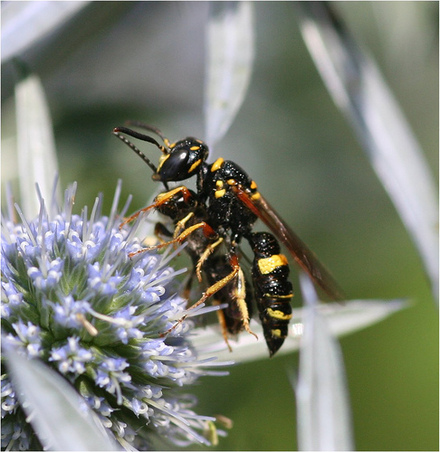
This small solitary wasp is Philanthus gibbosus, one of the species commonly known as “beewolves.” As the name suggests, they are predatory, and prey on bees. They are quite abundant, but this is the only time I’ve ever seen one grab a bee. Lucky shot.

Goldenwasp

Two very large wasps in the genus Sphex are common at flowers in summer. One is the blue-black S. pensylvanicus. The other is this species, the Great Golden Digger Wasp, Sphex ichneumoneus . Digger wasps dig burrows for their nests, and provision them with crickets, grasshoppers, and katydids. Although imposing, they are not aggressive. I’ve never been stung no matter how close I’ve gotten for a photo.

Resinbee

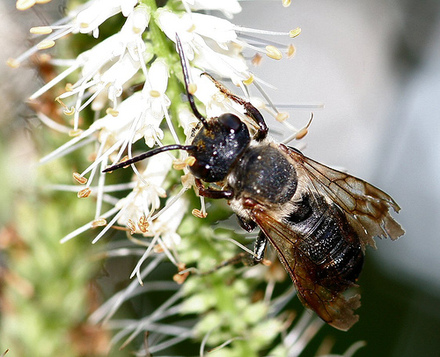
Only a week after the first Giant Resin Bee (Megachile sculptularis) was discovered in northern Michigan (by my friend Mark’s wife!), I colllected one at one of my study sites about 30 miles from my house. That same day, I came home and found this one in my yard. This species was introduced into the U.S. from Asia, with the first one being recorded from North Carolina in 1994. More info here. Another paper to co-author. I publish more stuff about insects than birds!

Woolcarder

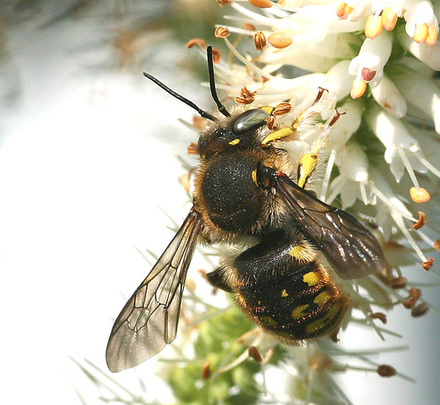
While we’re on the topic of introduced species, here are a couple of interesting ones. Wool carder bees are leaf cutting bees. Most leaf cutting bees cut semi-circular holes out of leaf margins and use the pieces to line their nests, which are in burrows or cavities. Wool carder bees use the “wool” from felted plants (like lamb’s ears). The species above, Anthidium manicatum, is introduced from Europe, purposely brought here as a pollinator.  Another species, A. oblongatum (below, in a photo I took at work), was introduced in 1995…I’m not sure if that introduction was intentional.

Otherwoolcarder Greatgoldenbumble

Finally, we’ll wrap it up with one of the several species of bumblebee I’ve found in the yard, the Golden Northern Bumblebee, Bombus fervidus.  They are particularly soft and plush looking, and very fond of the zinnias!

I got to 42 species photographed and identified in the yard so far, and another 20 species nearby. I’ve a few photos I’m still working on. The asters are still in bloom in the extended summer weather, so I might find a few more before frost.  This was a really gratifying project that I’ll continue next year. Now that I have learned to recognize many Diptera and Hymenoptera to family, I will probably be trying to photograph and ID some tropical species as well. My next opportunity will be January in Panama. Expect a tropical insect photo salon this winter!

Filed in Insects