≡ Menu

i have ear worms

Everybody gets songs stuck in their heads on occasion.  To most, this is an annoyance.  For me, it is major brain spam. I am so prone to this phenomena that I purposely avoid listening to most music, especially if it contains lyrics unless they are in a foreign language (although once after eating at an Indian restaurant I was possessed for days by a Bollywood instrumental).  These stuck soundtracks are known as “earworms”.

Research has found that people with compulsive tendencies and those with strong musical ability are the most susceptible to earworms. I am far from compulsive and have absolutely no musical talent.  Nor do I recall receiving any type of blow to the head during the era when many of my personal earworms first made their debut.  There was once a web site called “Maim That Tune” that picked a substitute earworm for you (this is like hitting yourself in the thumb with a hammer so you can forget about your backache). Nothing has worked for me so far to rid me of this affliction.

My earworms come in various degrees of intensity and levels of aggravation. Like any good scientist, I’ve categorized them:

Rapid Pygmy-Earworm (Earverma pygmaeus) — Brief earworms brought on by random thoughts or phrases, e.g., I’ll be thinking about going to the bank and end up with the song “I Want Money (That’s What I Want)” by the Beatles, going through my head for a little while. The most tolerable type.

Least Earworm (Earverma minimus) — This is a more typical earworm, the kind that afflicts many people. An obnoxious tune or jingle, often part of current pop culture, that replays for awhile. This would be something like “I’ll Be the One” by the Backstreet Boys, or “Borderline” by Madonna. Sometimes considered a subspecies of the Common Earworm (below), but my situation distiguishes it by the fact that a Lesser Earworm is, over the long term, temporary, whereas a Common Earworm is apparently semi-permanent.

Common Earworm (Earverma vulgaris) — A series of earworms that are well established, some for years, that when present typically last for hours or a couple of days.  Examples: “Paperback Writer” by the Beatles;  “I Want to Know What Love Is” by Foreigner; “Running on Empty” by Jackson Browne (always triggered by passing a cornfield); “Rebel Yell” by Billy Idol; David Bowie’s “Panic in Detroit” (surprisingly, not triggered by chaos in the town of my birth, from which I’m somewhat immune, but by any image of Che Guevara, which I see more than most people, having a house full of Cuban memorabilia); the tune and lyrics from an old One Hour Martinizing radio jingle; “Who’s Crying Now” by Journey; and “How Do You Mend a Broken Heart” by the Bee Gees.  Yes, it gets worse…

Greater Earworm (Earverma horribilis) — Major earworms that have plagued me for years.  These will get stuck in my head, playing continuously for hours, stopping for a bit, and starting up again over a period of 5 to 10 days.  They include disparate and truly annoying tunes that I never even liked in the first place, some of which are embarrassing to actually confess to, such as: “I Knew You Were Waiting” by George Michael and Aretha Franklin (!!!); “I Can’t Make You Love Me” by Bonnie Raitt; an old Enjoli perfume commercial; “Shake You Down” by Gregory Abbott (oh, the misery); and “I’m So Excited” by the Pointer Sisters.

It’s clear from this list that I don’t need to hear these songs to start a new round of torment (they don’t even play “Shake You Down” in elevators). No, these worms are festering inside me, waiting to periodically afflict me, like a long-running malarial infection.  Poet Robert Browning once said, “Who hears music feels his solitude peopled at once.”  I just wish the Pointer Sisters would leave me the hell alone.

UPDATE: I woke up this morning (16 Sep) with a Bay City Rollers song looping in my head.  This is a new and alarming development, and I’m having flashbacks of the little tartan jacket I made in sewing class in 1975.

Filed in Me

infinitely frustrating cats

Ever since I first discovered the Infinite Cat Project, I have been trying to take an appropriate picture of either of my cats to submit to the ICP web site.  The ICP is a gallery of recursive illustrations — of cats looking at the previous ICP cat on a computer screen.  I dearly wanted one of my cats to be #1000 in the array.  ICP is already at #1045 and counting, that’s how long I’ve been struggling.

The first problem is that the only interest my cats have in my computer screen is their determination to come between it and me.  I thought I could use that to my advantage, getting one of them in said position, clicking up the latest ICP feline, getting them look at the screen, and stepping back to snap a picture.  No, they are too peevishly self-centered to perform step 3 or to allow me to perform step 4.

Sophie is extremely restless and energetic.  She gets near a monitor only if my hands are in the same proximity, scratching her.  Any move away from her simply caused her to follow. Stay with the hands!  Stay with the hands! My husband and I tried numerous crafty hand/laptop maneuvers to no avail. Now you know why there are so few photos of her here, even though she is the cutest cat in the world.

I thought I’d have much more luck with Kady.  She is extremely lethargic — recall her title is that of the Bed Leopard. Once settled comfortably, she becomes inert dead weight. Unfortunately, her idea of comfortable does not include a hard surface near a computer monitor.  Kady also lacks nearly all of the curiosity cats are so famous for. Blank stares off into space, or annoyed looks through slitted eyes are about the extent of her repertoire.  A one-dimensional image of another cat does nothing to attract her gaze.  This substandard photo, which I did not submit to ICP, was the result of  a combination of intense psychological manipulation and dumb luck.  It is certainly not of the stunning quality and expert positioning evidenced, for instance, in cat #1045. I will continue my infinite quest to get Sophie and Kady into the Infinite Cat gallery.

Filed in Cat blogging

noisy butterflies

Pan_lep_crack This is a Variable Cracker, Hamadryas feronia, a member of a mostly Neotropical genus of about 20 species.  Variable Crackers are found from the southern U.S. through Brazil, and are one of several species of Hamadryas that can make an audible sound.  Males perch head-down on tree trunks and fly out at passing conspecifics, producing a burst of intense, double-component clicks.  Presumably, this is used for communicating between individuals, and the function may vary between species or even populations. The sounds are not percussive, as was previously thought, since the butterflies are able to make the sound with only one wing.  The mechanism appears to be the buckling of a stiff portion of the wings.

This leads us to the question: can butterflies hear?  It would seem that at least some can.  Many species of the large family of brush-footed butterflies, Nymphalidae, have a structure at the base of the forewing known as a Vogel’s organ, a thin membrane associated with an air sac and a sensory organ, similar to the tympanal “ears” of other insects. This allows them to detect sounds (or vibrations) of various frequencies.  Many species of butterflies have Vogel’s organs (some not well developed) but are not known to produce noise themselves.  There is speculation that Vogel’s organs may have originally evolved as bat or predator detectors, and that some families, such as Hamadryas, are regaining or co-opting the ability to hear and produce sound as a means of communication.

Like many other insects in the tropics, crackers also rely on excellent camouflage — you can see how well they blend in with the bark of trees. Crackers are perhaps one of the only butterflies in the world that might be easier to hear than they are to see!

Yack, J.E., L.D. Otero, J.W. Dawson, A. Surlykke, and J.H. Fullard.  2000. Sound production and hearing in the blue cracker butterfly, Hamadryas feronia (Lepidoptera, Nymphalidae) from Venezuela. Jrl. of Experimental Biology 203: 3869-3702.

Filed in Insects, Natural history, Travel

swans, take 2

While we’re talking about swans

My mitten-state neighbor TroutGrrrl over at Science and Sarcasm posted on the Michigan DNR’s request for Trumpeter Swan sightings. She gave a little overview and history of the effort to “reintroduce” Trumpeter Swans to Michigan.  This program is not without controversy, because although Trumpeter Swans are native to the U.S., there is no conclusive proof they ever nested in Michigan.  Or anywhere in the eastern U.S., where other states are spending time and resources on “reintroduction” programs.  Trumpeter Swans are even larger than Mute Swans, and raise some of the same concerns.

I can do no better than to refer you to the definitive source of information on this issue, a web site by Bill Whan and Gerry Rising.  There you will find a thorough examination of the evidence on whether this species ever nested in the eastern U.S., including a bibliography, and a discussion on Trumpeter Swans versus Mute Swans, including a piece by Kenn Kaufman called “Bad Ideas in Species Management: Big Ducks in Small Ponds.”  There is also a reprint of a Point/Counterpoint from Birding magazine specifically on the topic “Should Trumpeter Swans be introduced in the eastern United States and Canada?”  Read, and enjoy an analysis of a complex issue!

Filed in Birds, Urban issues

In a previous post, I wrote about the difficulty in using lethal control of White-tailed Deer because the public finds deer charismatic and engaging.  Another problem species that has many fans in the general public, confounding management, is the Mute Swan (Cygnus olor). Mute Swans are not native to the U.S. and can have a profound impact on aquatic ecosystems.

  • They consume about 8 pounds of submerged aquatic vegetation each per day, wiping out local beds and reducing plant viability; they uproot and destroy much more vegetation than they end up eating.  These beds are critical to migrating and wintering native waterfowl, and many other aquatic organisms — and consequently the food chain — depend on this vegetation.
  • Because of their size and temperament they displace smaller native waterfowl from breeding and feeding areas, including state-threatened species of colonial waterbirds (terns and skimmers) on the Atlantic coast.

However, people consider them a symbol of peace and beauty, and do not understand that their burgeoning numbers often need to be controlled.

A fine example occurred recently in Michigan, where an aggressive male swan was slated to be captured and euthanized after creating havoc with users of personal watercraft (arguably one of the most useless and damaging things a person can put in the water, but I digress).  People went nuts, wanting to save the swan.  Believe it or not, there were at least two weeks of negotiation between the state Dept of Natural Resources, the governor’s office, and a representative of a General Motors executive who eventually was permitted to take the swan to his farm!  This long pow-wow followed a request by the sheriff’s office, who had to step in as neighbors drew battle lines amongst themselves.  What a colossal waste of time and resources.  If only people would devote this much passion towards something that would really count, like passing a green space millage instead of putting up a Wal-Mart.

This frippery pales in comparison with a situation that began in Maryland. Since Mute Swans are not native, they were not protected under the federal Migratory Bird Treaty Act (MBTA).  When their population reached a critical mass in Chesapeake Bay, wildlife managers opted to cull 1500 birds.  In 2001, several animal rights organizations and individuals sued the USFWS, and the long and costly legal battle went back and forth and was not resolved until a recent amendment to the MBTA was passed excluding non-native species, and culling efforts were scheduled to commence this summer. Imagine the amount of time and money USFWS had to spend just to allow management of a destructive non-native species!  Is this what people purporting to care about the environment really want our strapped wildlife divisions spending their precious resources on?

[continue reading…]

Filed in Birds, Urban issues

as the worms turn

My field site is a typical urban forest, loaded with invasive species. The primary woody invaders are buckthorns (Rhamnus catartica and frangula).  I’ve wondered why the mono-patches of buckthorn usually had no litter layer beneath them.  It turns out this is likely due to a synergistic relationship between buckthorn and exotic earthworms.

Wiscglac First, a little background on the worms. Michigan has no native earthworms.  Neither does most of the upper Midwest, much of New England, or Canada.  The Wisconsin glaciation exterminated whatever species may have occurred in these areas.  Click on the map; the blue area is the extent of this last glaciation.  If you live in these areas, all the worms you find when you turn a spade of earth likely have European or Eurasian origins. Some arrived in soil and plant material brought by colonial settlers.  More recently, there has been a much larger influx from worms imported and raised as fish bait and for vermiculture. North America’s non-native wormifauna is comprised of nearly four dozen species, including the common species we call nightcrawlers (Lumbricus terrestris) and red wigglers (L. rubellus). Non-native earthworms are common in urban, suburban, and rural areas.  Wilderness areas are invaded by the dumping of unused fish bait, and the transport of soil in logging operations, for example.

Northern forests evolved to function with a thick layer of organic matter which acts as a mulch.  Soil properties, including delicate fungal relationships and low soil pH, are maintained when this litter is broken down slowly by native soil decomposers. Earthworms are very efficient decomposers.  They quickly break down leaf litter, and reduce or eliminate the organic soil horizon and change soil nutrient composition and availability. These actions have a cascading effect in the ecosystem, altering the soil microbial community and the composition of plant life. In one instance, a rare fern was extirpated because the loss and alteration of the litter layer disrupted the fungi relationship it needed to survive. Declines in some salamanders may be linked to exotic earthworms invasions, which reduce litter-dependent prey available to young salamanders.

I ran across a paper in the Chicago Wilderness Journal on the synergy of introduced earthworms and introduced buckthorn.  It notes that buckthorn leaves are high in nitrogen.  This makes them attractive to earthworms and other decomposers, so they break down rapidly. Mixed-species leaf litter, if it also contains buckthorn, also decomposes faster than it would if buckthorn were not present. Thus, buckthorn accelerates the reduction of forest floor litter, especially where non-native earthworms are present, exacerbating the problems associated with the lack of litter and changes in associated processes.  Where buckthorn and worms are present together, ecosystems receive a double-whammy, since buckthorn-dominated patches have elevated nitrogen, higher pH, and higher water content, all factors that can make restoration of habitats difficult even after the removal of the buckthorn.

I’m intrigued by the impacts of non-native species on ecosystems.  It seems we are just now beginning to scratch the surface of non-native/non-native and native/non-native interactions.

Resources:

Filed in Natural history

media attention

It was cool to discover that Slate.com linked to my blog in a recent “Today’s Blogs” column, quoting my comments on wildlife on military bases.  This prompted an email from an editor at the Los Angeles Times, who said she liked my writing and extended an invitation to write something for them. I’ve been asked by my husband how I can make money with my blog.  I’m sure fortune is just around the corner…

Filed in Flotsam and jetsam

best birds in panama

Pan_bbmo

I was multi-tasking while in Central America, but my husband and I managed to get in a good deal of birding every day. I went without any expectations of how many species I would see, and mostly just wanted to enjoy them. I kept a list, not because I am a competitive lister, but because I have a strongly anal-retentive streak. At the end of the first day, one of the first things we noted was how hard it was to pick which bird was most appealing, but just came up with a couple off the top of our heads. Thus, the “Bird du Jour” list was born. Here it is:

4 Aug, Metropolitan Nature Park, Panama City
Squirrel Cuckoo – bird du jour
Common Tody-Flycatcher – runner up
Tropical Gnatcatcher – 700th world bird

5 Aug, Barro Colorado Island, Panama Canal
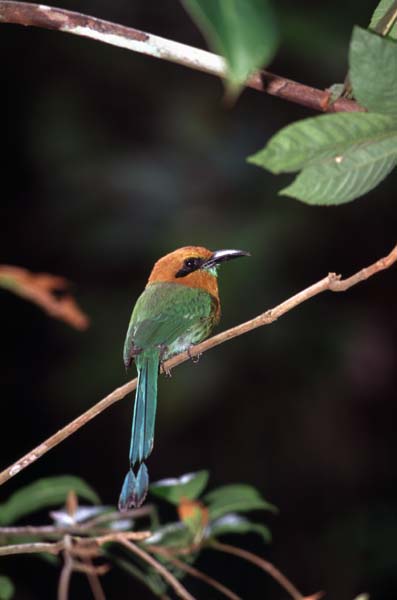
Broad-billed Motmot – bird du jour (I took the photo up top with a 105mm macro lens!)
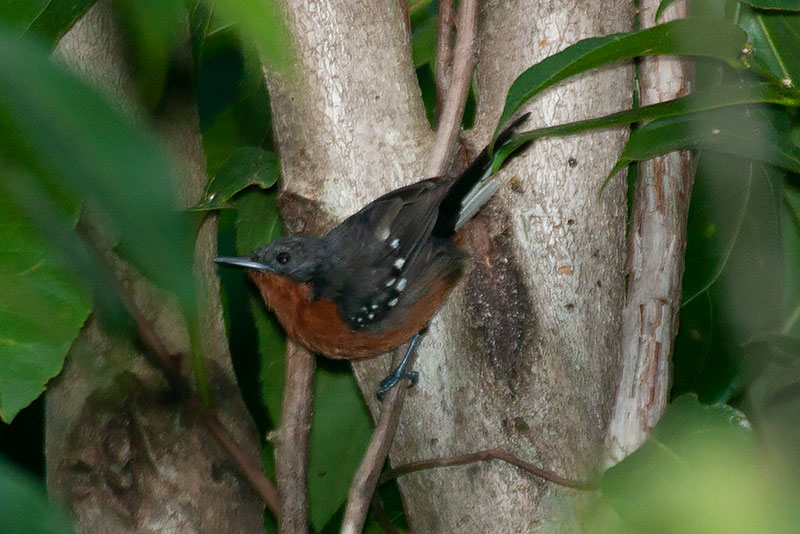
Dot-winged Antwren, female – runner up

6 Aug, Metropolitan Nature Park, Panama City
American Pygmy Kingfisher – bird du jour. A kingfisher the size of a sparrow! How great is that?
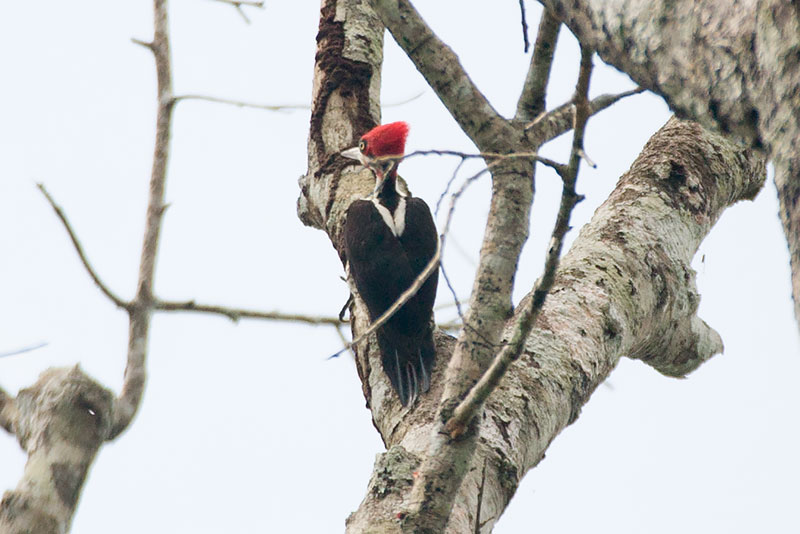
Crimson-crested Woodpecker – runner up

7 Aug, El Valle, Canopy Lodge area
Rufous Motmot – bird du jour, and also Bird of the Trip for me. Qualifications included beauty, interesting behavior (especially the pendulum-like tail swing), a fantastic mellow call, and accessibility (not too rare or hard to see, but also not too common).
Barred Antshrike, female – runner up

8 Aug, El Valle, La Mesa area
White Hawk – bird du jour
Black-faced Antthrush – runner up
Silver-throated Tanager – 100th life bird on trip

Pan_batfal 9 Aug, El Valle, Cerro Gaital National Monument, Caraiguana
Rosy Thrush-Tanager – bird du jour. An unbelievable color.
Chestnut-backed Antbird – runner up
Purplish-backed Quail-Dove – honorable mention, for drop-dead looks at a tough-to-see bird (hence, no good photo link)
Bat Falcon (left) – 800th world bird (although free-flying, we didn’t count this previous, rather tame Bat Falcon at Metropolitan Nature Park)
Scale-crested Pygmy-Tyrant – best name

10 Aug, El Chiru
Red-breasted Blackbird – bird du jour. Another stunner.
Pearl Kite – runner up

11 Aug, Canopy Tower, Plantation Road, Old Gamboa Road south
White-throated Crake – bird du jour, taking a long bath in road
Red-capped Manakin – runner up
Purple-throated Fruit Crow – best name
Bicolored Antbird – 850th world bird

12 Aug, Gamboa, Old Gamboa Road south, Ammo Dump ponds
Great Potoo – bird du jour
Boat-billed Heron – runner up

13 Aug, Pipeline Road (where birding was cut short by a broken-down vehicle and rescue vehicles stranded by a downed tree which had to be removed by machete, all in a drenching downpour. But hey, the trip was pretty cushy up to that point.)
Streak-breasted (Spectacled) Antpitta – bird du jour
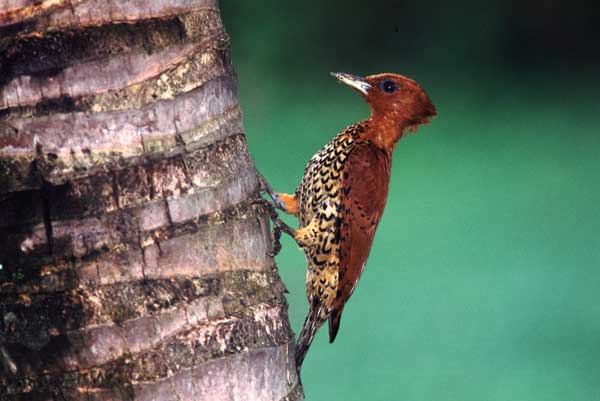
Cinnamon Woodpecker – runner up

I ended up counting 233 species.

Recommended: A Bird-finding Guide to Panama

Filed in Travel

mariposas de las noches

Uraniabl Dispatch from the road…

If you’ve spent time in the neotropics in late fall, chances are you may have seen Urania fulgens, a swallowtailed, diurnal migratory moth (often mistaken for a butterfly), sometimes called the Green Page, or Colipato Verde. In the last few days here in Central America, I have seen thousands, nearly every single one sticking to a similar bearing. In the lowlands, over water, in the mountains, in the cities, in the sun, in the rain — a steady stream of resplendent black and green moths (Urania signifies the green of Uranus, and fulgens translates as “brilliant”). I rarely see them land, but this one was up under the canopy of a filling station.

These moths sometimes travel 60 to 100 miles a day in their periodic mass movements within their range, which spans from northern Mexico into northern South America, although I have seen them (or a similar species) moving through Havana in mid-winter. These impressive movements are triggered by the increasing toxicity of their larval food plants, in the genus Omphalea. It is one of the countless examples of an endless evolutionary arms race between plants their consumers that is so prevalent in the tropics.

To defend against the herbivory of the moth larvae, Omphalea plants contain poisonous alkaloids. In response, Urania larvae have adapted with an immunity to the toxins. As Omphaleas face increasing pressure from growing regional populations of Urania, the plants produce more alkaloids. When the toxicity finally reaches a level that equals success for the Omphaleas, rendering them inedible, the Urania moths move out of the area in search of less poisonous populations of Ompheleas. Apparently, this cycles repeats itself on various scales throughout the range of the moth.

A conspicuous example of evolution is on the move here in Central America.

(Note on the relationship between the toxicity of Omphaleas and the movements of Urania. In short, Omphaleas produce increased toxins not over generations, but as individual/localized groups responding to grazing pressure by Urania larvae. See “Host plant toxicity and migration in the day flying moth Urania.”)

Filed in Insects, Natural history, Travel

getting googled

Like most other bloggers, I’m curious where my readers come from. Many come from search engines, via some rather strange search strings.  I’ve been collecting them since I started blogging, and was saving them up to post them as a list.  Then Rurality wrote a little story with hers, which I thought was a pretty cool idea.

Then I came across World Champion Search Strings at The Middlewesterner (a very fine blog even without this category).  Hands down, Tom has had the funniest, most bizarre searches pointing to his blog in the entire blogosphere.  So good, he has listed them, along with contributions from other bloggers (left sidebar on main page).  Further, there are so many, he periodically “retires” some classics.  You have to have a pretty eclectic variety of writing on your blog to get hits from these searches.  Who knows what Google AdSense would serve up on these blogs?

Go there, laugh, enjoy; try not to lose faith in humanity that there are folks out there looking for “hutterite women shucking corn“, “cheap amish hernia operations“, “penny farting sale” (HUGE collection of fart searches, including “slow motion farting“, “cure for prune farting” and “prime number farting“!), “why is the pope not decaying“, “pictures of pet gerbils dressed in irish clothes“, “emily dickinson’s men and a mustache“, and “flin flon tits“, and “old fashion underpanties for women“.

My insipid list follows.

  • photo flak seed
  • ivory blather
  • mayapple egg sacs
  • fecal analysis for conservation breeding in mammals
  • ivory-billed woodpecker nuthatch elevator
  • nigerian email scam cat photos hilarious blog
  • larvea [sic] hairy with legs
  • cat pooping on bed
  • woodpecker snail extinct
  • what causes a vurp
Filed in Silly stuff and bluster