≡ Menu

The New York Times reports that Richard Prum and Mark Robbins, two of the authors of a paper challenging the identification of Ivory-billed Woodpeckers on a video made by a team from Cornell, now feel the species does exist, based on new audio recordings provided by Cornell. The challenge paper’s third author, Jerry Jackson, is out of the country and has not heard the audio.

The Cornell team is slated to present new audio evidence at the upcoming meeting of the American Ornithologists’ Union; Cornell had 14,000 hours of recordings to analyze, a task that was not complete at the time they published their paper in Science.

I heard some of this evidence recently, and now that it is being reported in the media, I’ll mention what I heard and what else I was told existed. The audio evidence includes at least five recordings of the distinctive “kent” calls, including one recorded far from the original sightings, indicating at least one other bird. These were indistinguishable in sonograms from recordings made of IBWO in the 1930s by Allen and Tanner.

There are also about 80 recordings of double raps. These double raps are characteristic of woodpeckers in the genus Campephilus, and are vastly different from the rolling drum of the Pileated Woodpecker, which is in the genus Dryocopus. Most exciting was that one recording had a soft double-knock, followed by a closer, louder double-knock, perhaps a pair keeping in touch.

Prum and Robbins were offered the audio by Cornell yesterday, which included both “kent” calls and double-raps (including the pair mentioned above), and that they were “astounding” (Robbins) and “thrilling” (Prum). John Fitzpatrick, lead author of the Cornell Science paper, said he wished they’d sent Prum et al. the recording sooner. Indeed, if all the evidence had been provided to Prum & Co., perhaps the whole brouhaha would not have erupted in quite the way it did. I’ve heard two versions, both from primary sources: that Cornell offered better video to the challenge authors, but were not given enough time to provide it before the challenge paper was submitted; and that Cornell refused to provide better video when asked (remember, the challenge was based on the video evidence provided online in the supplementary materials to the Science paper).

Robbins said the challenge paper was a moot point; in a related article at Nature News, Prum said the manuscript has been withdrawn from the publication pipeline at PLoS Biology. (He also says he still thinks the video shows a Pileated Woodpecker.)

Perhaps I’ll be able to get further comment on how this all evolved. I was contacted by one of the challenge paper’s authors last week, who wanted to share with me some aspects of their side of the story. I expected to talk to him today, but now see why he was unable to make contact. Hopefully, I’ll still have the opportunity to bring you some news before I hit the road on vacation mid-week.

Filed in Birds

My constant companion in the garden is a male House Wren (Troglodytes aedon).  Naturalist John Burroughs noted that “Probably we have no other familiar bird keyed up to the same degree of intensity as the house wren.”  Indeed, as Burroughs went on to write, “The wren is habitually either in an ecstasy of either delight or of rage…. a lyrical burst one minute, a volley of chiding, staccato notes the next.”

Ever since he arrived in May, this wren has sung from dawn until dusk, having staked out his little territory in my yard. We have two wren boxes — the real thing, made to spec, not the crappy generic houses which become House Sparrow factories — and a nice snag with a wren-sized hole in it. We are organic gardeners, so our patch is buggy.  Several neighbors have boxes, too, so this is prime wren real estate.  The singing was especially zealous when a rival male was also attracted to all the housing opportunities.  It has taken a good chunk of summer to sort things out, with one wren in our yard, another across the street, and a pair of Carolina Wrens (Thryothorus ludovicianus) down the way (they’ll be back this winter, mooching mealworms from my office windowsill).

Male wrens construct “dummy nests” in nearly every available cavity. A female being wooed gets to check out all the different nest sites, and chooses her favorite to complete decorating.  I usually take pity on the male wrens that have ended up here, working tirelessly hauling twigs much longer than themselves to the boxes, and struggling to insert them.  I often snip some of my spring prunings into wren-sized pieces and place the piles in handy locations.  One year, I was amused to watch a wren fill up one of the houses with styrofoam packing peanuts, which he was garbage-picking behind somebody’s garage. That nest was apparently a loser, and was never inhabited.  But this year, a pair has taken up homesteading in one of our boxes.

At this point in late July, the song of most other birds has been silenced by mid-summer brood-rearing weariness, with the only avian soundscape being the inharmonious chirping of House Sparrows and the various strident demands of young cardinals and robins. The only bird still singing with enthusiasm is the House Wren.  He tosses out a brief volley of song before he pops in the box, and he follows up with another effervescent outburst after he leaves it.  His mate comes and goes in more modest silence.  Females of some populations do sing at times, but usually lack the male’s melodious style.

This pair lost their first brood, but a new batch of eggs was recently laid. We are eagerly awaiting the debut of the youngsters. When their noisy begging combines with the anxious chiding of their attentive parents, you’d think a miniature maraca factory was traveling through the underbrush.

The liveliness of wrens is a perfect foil for late summer lassitude. As I sit on the patio with a paperback, or survey the garden with my morning cup of coffee, I find that the wren appears from nowhere, and begins to scold me, it seems, for my lack of industriousness. It was easy to feel guilty for relaxing, until I noted that the wren offered the same extreme commentary when I was busy weeding, transplanting, or engaged in any other activity which felt was a righteous expenditure of energy. No matter.  Whatever a wren has to say, I’m willing to listen, even if it takes all summer long.

Filed in Birds, Natural history

The next forum for presentation of evidence on the IBWO will be at the meeting of the American Ornithologists’ Union in late August in Santa Barbara. Presenting papers at conferences of this type are a typical way for researchers to present their work prior to publication in a peer-reviewed journal.

On 24 August, four papers are scheduled:

  • Recent acoustic search for the IBWO — R. A. Charif, et al. [Russ is a research biologist in the Cornell Lab of Ornithology’s Bioacoustics Research Program]
  • IBWO survey methods — R. W. Rohrbaugh, et al. [Ron is or was director of natural resources and visitor services at Cornell]
  • IBWO evidence — K. Rosenberg, et al. [Ken is director of conservation science at Cornell]
  • Refuge management and IBWOs — R. J. Cooper [professor of forestry, University of Georgia]

These talks should go into more depth, and help answer some questions about methods and additional evidence. One thing I know is that there were some 14,000 hours of audio recordings made in the Arkansas swamps, and Cornell is STILL not quite done analyzing all of it. However, as of last week, there were about 80 different recordings of the double-knocks thought to be distinctive of IBWOs, including some 100 km away from the area of the sightings, indicating more than one bird in Arkansas. There are also recordings of “kent” calls, with identical sonograms to those recorded in the 1930s.

On 25 August, John Fitzpatrick, lead author of the Science paper and director of Cornell, will give an evening talk entitled, “Rediscovery of the Ivory-billed Woodpecker and its conservation implications.” And by the way, Rick Prum is also on the docket to give an unrelated paper, and Jerry Jackson will be chairing another paper session. It should be an interesting conference!

I think many of the criticisms of the Science paper are healthy and well founded. I have said that I believe the weight of the evidence as a whole supports the identification of IBWO, but I have seen things that are not easily available to the general public. I think the Cornell team was under tremendous pressure to pull together what evidence it had, publish it, and make an announcement before the whole business was made public by leaks, which were, by mid-April, springing forth. So the weaknesses in the paper come from both the evidence being less-than-optimal, and the paper perhaps being rushed.

A Sunday New York Times article about the Ivory-billed Woodpecker flap reports that birders David Allen Sibley, Pete Dunne, and Kenn Kaufman all feel that the Science paper published by the Cornell team offered insufficient proof that the Arkansas sightings were indeed IBWOs. These men are celebrities in the birding world, and their opinions carry some weight. On Birdchat, the big birders listserv, Laura Erickson stated it well:

The debate seems to be descending into a scorched-earth battle, from which there will be no winners and the biggest loser will be conservation of the southeastern bottomland forest and the species that depend on it. And when the documented sight records of seven independent observers have no “scientific” weight, what with the magic of Photoshop and digital video manipulations, are we headed back to the days when the only acceptable “scientific” sightings were from the barrel of a shotgun?

I have not interjected much of my own opinion into my posts on this topic; my interest is mainly in the process of science, the often contentious interface between birding and ornithology, and offering what I hope is some clarification and analysis.

Here I will say that when the announcement of the IBWO rediscovery was made, I admit that the whole thing felt very “managed” to me, with a bit too much fanfare and self-congratulatory back-patting and not enough science for my taste. But, given the situation, how else could they have reacted and presented the information? Nearly six years ago, even before the failed Zeiss search, someone very close to me was part of a small team, including David Luneau, who searched the Pearl River in Louisiana for IBWO for a week. Each night I was updated, and each night we debated the question, “What happens if you DO find it?” Later, I tossed this around with another good friend, who was part of the Zeiss team.

There seemed to be no ideal answers, no perfect way to proceed from the first sighting considered really solid, no way to keep everything truly confidential until unequivocal evidence was obtained, no way to avoid a clash of professional and personal interests, no ideal presentation that would sway all skeptics and not ruffle at least some feathers. Now of course, we are all now dissecting the decisions made by the Cornell team. I, for one, think they probably did the best they could have under the circumstances, and with the habitat acquisition and protection accomplished a feat I would not have thought possible.

I am a natural skeptic and also admit to being overly critical, but I’ve come to the conclusion that I’m not going to second-guess this one. In my own little world of academia as well as in the birding community, I can sometimes feel like I’m tiptoeing through a minefield. I’m glad I wasn’t one of the people who had to figure out how to best proceed with the IBWO. I’m ready to give this one a rest for awhile.

Filed in Birds

As noted in my original post, the New York Times Science section today confirmed the existence of the paper to be published questioning the sightings of the Ivory-billed Woodpecker in Arkansas, as well as the identity of the authors. It wasn’t really my intention to provide “breaking news”, but to provide perspective, balance, and commentary on the story. However, long, long ago I was a journalist, and it was fun getting a jump on the Times, even if only by 12 hours or so.

The news feeder at Nature also posted a piece today. While the Times article says the authors did not want to divulge the journal they submitted to, the Nature piece confirms another part of my post, that the Prum et al. paper will be published in an online journal, one of the Public Library of Science (PLoS) endeavors. This is undoubtedly PLoS Biology, an open access journal. [update: confirmed on 22 July by NPR, in which they note the journal has formally accepted the paper]

I talked a bit about Prum et al.’s choice of publication in my first post. I’ll just add now that one of the reasons they may not have chosen to publish their challenge in Science is that Science restricts these types of responses to 750 words. More interesting is their choice of an open-access publication. It is probably more expedient; I’m sure there are a lower volume of papers being submitted. But I believe publishing open-access might have a more ominous result.

Publishing in an open-access journal means that everybody can read the paper online, no subscription, no per-view fee, no restrictions. Everybody — including legislators and policy-makers who do not have access to the original paper in Science, which is now only available at a cost. The Nature piece echoed my concerns that the Prum et al. paper could have serious ramifications on endangered species conservation. Publishing open-access may provide an easy source of ammunition (without balance) for those willing to use normal scientific dissent as proof we need to raise the bar to unreasonably high standards prior to species protection. Uh-oh.

Filed in Birds

MbowersThere have been recent rumors, on the Internet at the Arkansas and Tennessee birding listservs, regarding a paper by several researchers, including a well-known Ivory-billed Woodpecker (IBWO) expert, that will question the validity of the Arkansas sightings of the IBWO last winter.  This has already caused some uproar and knee-jerk reactions. Here is what I know; before passing judgment on what has come out so far, please read to the end of the post for commentary.

I have it from several sources that the paper’s authors are Richard Prum, Professor of Ornithology, Ecology and Evolutionary Biology, at Yale University; Jerome Jackson, Florida Gulf Coast University and author of the Birds of North America account and a book on IBWO; and Mark Robbins, Collections Manager, Ornithology Division, University of Kansas Natural History Museum. Jackson’s name should come as no surprise, having already been bandied about as an author, and as the only IBWO expert not on the Arkansas Cornell team who is a candidate to write such a paper.

The paper has been submitted to an online journal, which I understand is peer-reviewed and perhaps British, and is the final revision stage. The authors of the paper in Science on the Arkansas rediscovery (Fitzpatrick et al.) have been invited to publish a response in the same issue, and they will be doing so.

Prum et al. contend that the images in the David Luneau video, which are the centerpiece of the Fitzpatrick et al. paper, are not an IBWO, but perhaps an abnormally-plumaged Pileated Woodpecker (PIWO). They apparently extrapolate from there that there is not sufficient evidence to conclusively prove that any of the Arkansas sightings are actually IBWOs. NOTE: It is my understanding that Prum et al. do not say IBWOs do not exist, only that the evidence provided for the Arkansas sightings as published is not proof.

Regarding that evidence, I was told by an extremely reliable source that Prum et al. did not request from Cornell permission to look at original data and materials. When Cornell learned that the evidence would be disputed, they offered, for example, high-resolution copies of the video, but were not given sufficient time to deliver these materials The Prum et al. paper is based on the data provided in the Fitzpatrick et al. Science paper and the supplementary materials to that paper available online.

The video clip provided in the supplementary materials online is at 4x magnification at 1/2 speed. Also provided in the supplementary materials are a series of video stills in PDF, which are tiny on a computer screen. Figure S4 provides a graphical summary of a comparison of a critical measurement, as estimated from IBWO and PIWO museum skins, from 1935 IBWO film footage by Arthur Allen, and from the bird in the Luneau video. All estimates of this measurement of the Arkansas bird exceed that of any PIWO they measured (n=24).

I am keenly interested in reading the Prum et al. paper because I am curious how they reached their conclusions given the limited material they worked with. In addition to the video version online, I have seen a much longer high-resolution clip at original speed and magnification, 1/8 speed and 4x magnification, and a series of stills, plus films at similar speeds and magnifications shot by Cornell using IBWO and PIWO models as comparative simulations, which help support the IBWO identification.

Plumage can be deceiving, of course, but size is more convincing. Figure S4, albeit using small sample sizes, is quite compelling in support of IBWO, especially when one examines how Fitzpatrick et al. derived these measurements (I’ve seen these methods and figures, which are not available in the supplement). I am especially curious to see how this is countered.

Here is what we need to bear in mind. The IBWO sightings represent the biggest news in the birding world in recent memory, and the news was accompanied by a fervent and impassioned positive response by the public. If not for that, the fact that there will be a rebuttal to the published report would be a non-event. Criticism of published papers, often based solely on the materials presented, appear all the time in journals. All facts in science are provisional and subject to challenge; skepticism is an accepted and necessary part of the scientific process.

I am a little surprised that although Prum et al. are engaging in a routine and time-honored act — and even without disputing the actual existence of IBWOs — that they would do so at the risk of being viewed by the public as turds in the punchbowl. Perhaps worse for their careers might be their choice of not making the challenge in Science, where the original paper was published, as would be the usual procedure. Science is one of the most respected peer-reviewed publications (which is not to say it is infallible). That Fitzpatrick et al. were able to publish in Science, and were willing to risk their own reputations when other researchers claiming to have authentic IBWO proof has resulted in them being labeled Bigfoot-chasers, adds weight to their findings. We will have to see where the Prum et al. paper is published, but if it is indeed a foreign online-only journal, the choice will no doubt be seen as desperate and the material not held in high regard, deservedly or not.

I am also a little concerned that in today’s political climate, where there is a prevailing anti-science, anti-environmental sentiment, that the criticism will be used as an excuse by some not to spend further money on habitat acquisition, which has been an enormously beneficial outcome of the IBWO reports. I can see those people who would like to see endangered species protections weakened (and who do not understand the scientific process) trumpeting this criticism as an example of how experts cannot even agree on species identification, and therefore requiring hugely inflated standards of proof before management can occur.

This is extremely unfortunate. There is a principle known as Occam’s Razor which states that the simplest explanation is the best. From the complete suite of evidence I have seen, including further audio recordings of both calls and drumming, and details on the methodologies used to reach the IBWO identification, I conclude that the most parsimonious explanation for the findings is that there are IBWOs in the Big Woods of Arkansas, or certainly enough evidence that further exploration and habitat preservation is warranted.

We need to keep the Prum et al. paper in perspective. We need to recognize that Prum, Jackson, and Robbins have all made worthy contributions to ornithology; Jackson in particular has made very important contributions to our knowledge and understanding of IBWOs. And most of all we need to respect that the model for the scientific method relies not on taking matters at face value, but examining facts critically by offering challenges and counter-challenges. Rather than presume the Prum et al. paper was motivated by personality conflicts and egos, as some have suggested, I hope that it is in the spirit of scientific inquiry that Prum et al. present their publication.

Filed in Birds

the poetry of leaves

Leaves I spend a lot of time in forests. As an ornithologist, I spend a lot of time looking up in forests. With luck, I see the bird I am searching for. If not, my eye will wander the canopy, appreciating the play of light through the leaves. One day, my mind, as well as my eye, wandered. Was there a pattern to this seemingly chaotic riot of green? Nature, I know, is a most efficient master. It seemed reasonable that leaves, as food factories designed to carry out photosynthesis, should probably be positioned in order to maximize their exposure to sunlight.

This is, in fact, the case. It may not always be easy to see, because environmental conditions, physical constraints, injuries, etc. obscure the patterns, but the method of leaf arrangement, or phyllotaxis, on plants is both precise and quite astounding.

There are three basic ways that leaves are arranged on the stems of plants or trees. One is whorled, with three or more leaves arranged in a whorl around the stem. This is found on catalpa trees, as well as many herbaceous plants. A quick look will verify that the leaves of each whorl are placed so that they do not block the light of the previous whorl.

Another is opposite. Among tree species featuring opposite leaves are maples, ashes, dogwoods, and horsechestnuts — you can remember these genera by the acronym “MAD Horse”. Each rank of leaves will emerge at right angles to their successors, thereby not interfering with light transmission.

The third and most common leaf arrangement is alternate, which is found on nearly every other deciduous tree and many plants. In this array, leaves are ordered up a stem in an alternating pattern. The leaves don’t just alternate, they actually spiral around the stem so that each leaf gets maximum light exposure. Nor are these just ordinary spiral patterns. They are organized with mathematical precision.

Fib2 Each leaf is positioned a partial turn around the stem from its successor. In each species of tree, this angle remains constant throughout the tree: every branch around the trunk, every twig around each branch, and every leaf around each twig is at the same angle. The pattern of any given species can be written using a fraction. Although this is easier said than done, is accomplished as follows.

Start with a leaf. Count the leaves going down the stem until you reach another leaf directly below the leaf you started with (in other words, located in the same vertical position on the stem). Also note how many turns around the stem it took to reach that leaf. A pattern of five turns consisting of eight leaves is written as the fraction 5/8, shown in the illustration (click to enlarge; image source Jill Britton’s Investigating Patterns page).

Many grasses have a fraction of 1/2 while beech trees come in at 1/3, and oaks, like many hardwoods, are 2/5. Holly leaves are arranged in a 3/8 pattern, and willows have the 5/13 phyllotaxy. If you have any mathematical prowess, you are getting a creepy feeling here. The numerators and denominators of phyllotaxic fractions are nearly always numbers in the following series:

1, 1, 2, 3, 5, 8, 13, 21, 34, 55, 89, and so on, where each number is the sum of the two numbers preceding it. This is known as a Fibonacci sequence, named for an Italian mathematician.

Fibonacci numbers abound in nature. If some enlightened teacher had pointed this out to me in grade school, I would have been inspired by numbers rather than bored and intimidated by them.

One of the most frequent and easy to observe examples of Fibonacci numbers in the natural world are flower petal numbers. Go count some. And the preponderance of botanical examples of Fibonacci numbers leads me to believe this is why four-leaved clovers are so rare. But I digress. Let me continue to dwell on those phyllotaxic fractions.

Take a look at the head of a sunflower, packed with seeds. The seeds are arranged in collapsed spirals, one winding clockwise, and the other counterclockwise. For example, 21 counterclockwise spirals crossing clockwise spirals creates the fraction 21/34, another fraction in the Fibonacci sequence. Why would florets, and therefore seeds, need to be in such an exact pattern? Rather than the most efficient use of light, in this case it is the most efficient use of space, resulting in the maximum number of seeds.

Then there are pine cones. A fraction of 8/13 is found in a pine cone where it takes five circuits around the axis of the cone touching 13 scales to reach a scale directly above the first. Not only an efficient use of space and increased structural stability, but cones configured in this fashion channel wind-borne pollen to the ovules for the best probability of pollination and reproduction.

This is an elegant example of evolution at work, for any small adjustment that resulted in an advantage in light gathering, optimal seed arrangement, or increased fertilization would put a plant at a competitive advantage, and would be selected for. Over millennia, plant cells have evolved a way to organize themselves for optimum performance, following precise mathematical models.

It’s something you can count on.

Additional resources:

Filed in Natural history

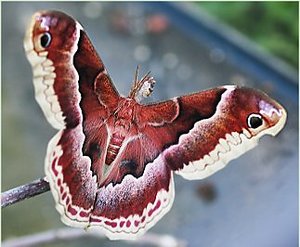
This must be my Saturniidae summer. After experiencing the quiet wonder of the emergence of two Polyphemus and lamenting that I rarely see wild silkmoths anymore, I spotted my first Cecropia in over 20 years, and now I’ve encountered my first Promethea moth, Callosamia promethea.

Last week I found two cocoons on a sumac, one of which was empty. I recognized them as silkmoth cocoons, but recalled no species with larvae that fed on sumac. The cocoons matched those of the Promethea, which feeds primarily on sassafras, spicebush, and cherries, although I didn’t notice seeing these in the immediate area of the cocoons. I brought the cocoon home, wondering if it was alive, and if so, what would emerge.

Promethea When we returned from our long weekend, I looked in the aquarium and there was a gorgeous Promethea. Like all silkmoths, this one was breathtaking, richly patterned in shades of cinnabar, rust, and cream, with a sprinkling of lavender. This coloring indicated the moth was a female, as Prometheas are highly dimorphic; the males are the color of dark chocolate. But there was another giveaway to its sex. The sex of silkworm moths can be determined by the shape of their antennae.

Faces2 Moth antennae come in various shapes. Some are filiform (threadlike) and simple (no lateral projections). Most do have projections, which are described by their structure; for example, ciliate (hair-like), setose (bristle-like), dentate (tooth-like), or pectinate (comb-like, singly or in pairs). Excessive pectination, resembling a feather, is called plumose. Recall my Polyphemus moths, which were male (top right). Now there are some plumose antennae! The antennae on the female Promethea, as you can see, are much more modest (below right).

Adult silkmoths live for just a fortnight and do not eat or drink. Their goal is to reproduce. Most females don’t even fly until they have mated. They just sit near their old cocoons, release pheromones, and await a male. Here, then, is the reason for the male’s extravagant antennae: they are used to sweep the air for the scent of a female. Equipped with exquisitely sensitive chemoreceptors, they are able to detect a female two to five miles away, sometimes much farther.

Females of different species release their pheromones at different times of the night. Polyphemus females “call” before midnight, Luna moths begin around the witching hour, and Cecropias begin at 2 or 3 AM. Prometheas are one of the few diurnal silkmoths, and call in late afternoon.

When this Promethea did not attract a male in two afternoons, I returned her to the area where I found her, releasing her to fulfill her purpose. Somewhere, I hoped, the elaborate feathery antennae of a male will detect a few molecules of her scent, and he will go to her, following her invisible, silent, siren song.

Filed in Insects, Natural history

resting places

Over the holiday weekend, we took back roads through a lot of small towns in rural areas with stagnant economies.  Now granted, money is tight in these parts, but it seems unnecessarily frugal, not to mention unhygenic, to lay out your loved ones in a storage unit, next to the old baby toys, excercise equipment, and furniture you’ll never get around to refinishing.

Filed in Silly stuff and bluster, Travel