≡ Menu

run away! run away!

On Saturday I participated in the North American Migration Count, in which individual counties are scoured by teams of birders each year on the second Saturday in May to produce a “snapshot” of spring bird migration. I live in a very urbanized county, but nonetheless came up with 96 species, even though the weather turned windy and drizzly by afternoon.

We saw 19 species of warblers, including outstanding ones such as Golden-winged Warbler (Vermivora chrysoptera) and many Blackburnian Warblers (Dendroica fusca). Even so, the highlight of the day was flushing an adult American Woodcock (Scolopax minor) and her brood of four young. Woodcock are chubby, clumsy-looking shorebirds adapted to life at the interface of woodlands and open areas, where they feed upon earthworms and other soil invertebrates with their long, rubbery bills. Their dietary Amwogr habits require them to spend lots of time looking down, so in order to detect predators, their eyes are situated far back and high up on their heads, adding to their rather witless looks. Personally, I disregard the awkward construction, and think that woodcocks are one of the most beautiful of birds. Their plumage is intricately patterned in an array of earth tones, providing expert camouflage in dead leaves and vegetation.

Woodcocks are probably best known for their spirited and novel courtship displays, which involve a male stomping around in an open area at dusk, making a “peenting” sound. He then launches himself high into the twilight, spiraling on twittering wings and falling slowly to earth, all the while emitting twinkling, chirping music. Peent, launch, land, repeat. Such is the renown of this sky dancing, it has earned the woodcock many nicknames, including timberdoodle, night partridge, dropping snipe, and Labrador twister.

On Saturday, as my husband and I entered a forest trail from a clearing, he flushed a woodcock. I have scared up many of these birds, as they tend to hang around my field site and sit in my net lanes, rocketing up underfoot as I open the nets at dawn. This woodcock, though, flew away slowly, legs dangling, and making a pathetic sound.

“That’s weird,” I said to my husband, “Is there a nest nearby?”

We looked in front of us and saw not a nest, but a woodcock chick about 10 to 14 days old, judging by its size and extent of feathering. Some down remained, but the partially feathered chick was already gorgeously patterned, and it appeared to melt into the trail side vegetation. I reached for my camera, but suddenly the chick stood up, raised its wings straight into the air, erected its stubby, fan-shaped tail, and ran away. Within seconds, another chick popped up and did the same, followed by another sibling, and still another. These chicks had been completely invisible, and now they were dashing pell-mell through the forest, zig-zagging in different directions, wobbling and wavering as if they were racing on a tightrope, their wings high over their backs as if miming “We surrender! We surrender!”

It was an incredibly charming sight, although it made us wonder why, if the young were so perfectly camouflaged, would they make such a wildly conspicuous retreat? Apparently, in addition to being inexperienced runners, especially over an uneven forest floor littered with randomly placed obstacles, woodcock chicks have a difficult time keeping balance simply due to their ungainly physique. Raising their wings, then, helps them keep their balance. After witnessing this hilarious get-away firsthand, we decided it must also serve to completely disarm an enemy, who would only be able watch in surprise and delight as the next generation of timberdoodles made their great escape.
Filed in Natural history

The Harvester (Feniseca tarquinius) is a handsome small butterfly, but not outstanding; it is easily confused with other orangey species such as coppers or skippers. But this unassuming insect, no larger than a man’s thumbnail, is unique in North American lepidoptera. The life cycle of the Harvester is tied to that of woolly aphids, and is a fascinating lesson in ecological interplay and interdependence.

Every schoolchild learns (or once did) that butterflies lay eggs on plants, the caterpillars feed on the vegetation, grow, form a pupa, and eventually emerge as an adult butterfly which will probably feed on flower nectar, but may instead feed on rotting fruit, sap, or some other organic matter. The Harvester does something different just about every step of the way, breaking all the rules.

Female Harvesters lay their eggs among woolly aphids (Neoprociphilus, Pemphigus, Prociphilus, and Schizoneura). These insects are interesting in their own right. They have both winged and wingless generations, nearly all of which are female, and they usually require at least two different hosts. For instance, the woolly alder aphid (Paraprociphilus tesselatus), a species in which Harvesters are frequently associated with, requires both alders and silver maples, with different generations feeding on each tree. Lucky for me, the woodland where I work has both tree species in abundance.

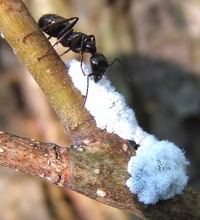
Aphids1Woolly aphids, like other aphids, feed on plant juices and subsequently exude undigestible plant sugars as a sweet substance referred to as “honeydew.” This honeydew attracts ants, which will carefully tend and protect aphids in order to exploit this handy source of nutrition. There are any number of species of aphids and ants that have this type of mutualistic relationship. Enter lepidoptera: some ant species have the same type of relationship with larvae of the butterfly family Lycaenidae, nearly all of which also produce honeydew and thus prompt the same interest and devotion from ants.

Harvesters are also members of the Lycaenidae (the plot thickens), but the dietary habits of their larva turn the typical ant/caterpillar alliance on its ear. When Harvester larva hatch, they eat the woolly aphids; they are the only carnivorous butterfly larvae in North America. Aphid-munching puts Harvesters a bit at odds with the ants, and so the larva will sometimes conceal and protect themselves under a mat they spin from silk and festoon with aphid carcasses. Recent research has also found that Harvester larvae can produce a chemical camouflage that mimics the species of aphid on which they are feeding. These larvae are therefore undetectable to the ants, and are spared the ant-rendered molestation which invariably befalls other aphid marauders.

Harvester larvae pupate into chrysalids that are said to bear resemblance to a monkey’s face. I sort of think they look more like dog faces, but then again, some people see faces in tortillas, ceiling tiles, and grilled cheese sandwiches, so who am I to assess these effigies? Harvester_a

Adult Harvesters are no less dependent on woolly aphids, they also feed on aphid honeydew. A Harvester butterfly possesses a proboscis that is too short to be of any use in sipping nectar, but is well adapted to imbibing on honeydew.

Harvesters, then, which are endemic to eastern North America and the only representative of the subfamily Miletinae in the New World, are never far from the suite of tree species which host woolly aphids. Because not all host trees will be infested with aphids, Harvester populations can be quite ephemeral. Even though all the elements were in place here in my local patch, I have looked for this remarkable butterfly without success for over ten years. I feel quite satisfied to have finally been rewarded with a first-hand glimpse at its intriguing life.

Filed in Insects, Natural history

Today, at dawn, I went out in the field to open my nets and heard the unique and exuberant R2D2-like song of the Gray Catbird (Dumetella carolinensis). They were back from their southern winter vacations. As a banding intern in New England, I was anxious to handle colorful warblers and shy, subtle sparrows, yet the most abundant bird we banded was the Gray Catbird. When I began my bird studies here in the Midwest, I was inundated with them once again. I found this dull and unexciting at first, but have since grown to truly love and appreciate this species, and I look forward to their return each spring.

Catbirds have a lot of personality, making up for their fairly monochromatic appearance. Most species are quiet and docile while being banded, but catbirds tend to whine and complain. I vividly remember one hot day in late spring, back when our banding lab was located in an old barn. We had the barn doors wide open to catch a breeze. As one of my volunteers was banding a fussy, bitching catbird, another one flew in the door and landed on the back of the chair next to me. It cocked his head and assessed the situation with a bright eye. Seeing he was unable to assist his comrade in its “ordeal” of obtaining a silver bracelet, he gave his signature cat-like mew and flew back out the door.

Catbirds nest here, and many banded birds return year after year.  I finally got a look at the legs of this singing bird, and sure enough, it was banded.  Welcome back!

Filed in Birds, Natural history

garlic mustard blues

I wish I could talk more about birds in this space, but what with the snow (we ended up with “only” 4.5 inches) and cold, migration is pretty much at a standstill. I’m left to cope with one of my spring routines: destroying Garlic Mustard (Alliaria petiolata) in my study plot. Garlicfloor1

My field site is full of invasive species. Garlic Mustard is the most annoying and conspicuous. Here are the dirty facts:

  • A European native first reported in the U.S. in New York in 1868; now most abundant in northeast and Midwest, but satellite populations elsewhere.
  • A self- or cross-pollinating biennial which produces an average of 350 seeds per plant, but up to 7900 seeds in robust individuals; <5% of germinating plants survive to flower.
  • Seeds remain dormant from 8 (south) to 20 (north) months; seed bank remains viable for 5 years.
  • Tolerates full sun to full shade, moist floodplains to dry, sandy sites, and a wide variety of soils (but intolerant of acidic soils).
  • Disturbed areas are most susceptible to invasion, where it can dominate within 10 years; however a study (Biological Invasions 1:169-179, 1999) in Illinois found a mean rate of spread at 5.4 m year in high-quality, undisturbed forest, with annual means increasing from 9.0 m in year one to 31.8 m in year eight.

The impact of Garlic Mustard monopolization is mostly anecdotal at this time, although there is evidence that sites dominated by it have low native herbaceous species richness. Garlic Mustard produces several phytotoxic chemicals that may inhibit mycorrhizal activity, and therefore growth of native species. It may alter habitat suitability for salamander, insect, and earthworm communities (although ironically, in northern North America, most earthworms, isopods, and some other leaf-litter denizens are also non-native). It definitely interferes with reproduction of two native butterflies, the Mustard White (Pieris napi) and the West Virginia white (P.virginiensis) which lay their eggs on the Garlic Mustard, where their larva cannot complete development.

My beef with Garlic Mustard is that it so thickly blankets the forest floor, at a height of about three feet, that it must somehow impact ground-foraging birds such as thrushes (click on the photo for a look at what most of the forest here looks like by June). It seems to me that it has got to be difficult for birds to efficiently explore the forest floor and scratch in the litter when this plant has taken over. If there are negative impacts of Garlic Mustard infestation on forest floor invertebrates, then prey items may be reduced. Finally, a bird foraging in Garlic Mustard would have little ability to monitor for predators in the tall, dense stands, which may deter them from foraging in Garlic Mustard stands. Nobody is currently studying these impacts, as far as I know, but I am investigating it…any collaborators out there for a full-blown study?

Whatever its impacts, Garlic Mustard is not welcome in my study plot, which I try to maintain in a steady state of succession and floristic make-up. That way, I minimize any bias in my current work that might be introduced via changing vegetation, and preserve a control plot for that future study!

Filed in Environmental issues

“It’s kind of like finding Elvis.”
“This is the most exciting ornithological discovery in a long, long time.”

These are a couple of the comments from prominent birding experts regarding the reported discovery of the Ivory-billed Woodpecker along the White and Cache rivers in Arkansas, a bird thought to be extinct. This very charismatic species has been a Holy Grail to birders for decades. Every reported sighting incites great excitement, and more recently, extensive searches, such as the unsuccessful 2002 expedition sponsored by Zeiss Sports Optics. Now we have confirmed that at least one bird is still alive.

I am not sorry this species still survives, but I frankly feel a little sorry that it has been publicized. The dog finally has the bumper of the speeding car firmly in mouth. Now what?

Conservation issues. So far, only a single male Ivory-billed Woodpecker has been found. I don’t doubt there are others; with a maximum life span of perhaps 15 years, there clearly has been some reproduction since the last confirmed sighting in 1969. Given the herculean yet unsuccessful efforts by professional and amateurs over the years to find ivory-bills, it seems that the odds that there is a viable, genetically diverse, reproducing population in the U.S. seems vanishingly small. What does that mean to conservation efforts?

Although it is a listed species, little money or effort has been spent on the Ivory-billed Woodpecker under the Endangered Species Act (ESA) because its current status was unknown. This discovery might logically trigger a process under the ESA including designation of critical habitat and the development of a recovery plan, both of which are time-consuming and expensive, but necessary, components of species conservation under our current law.

A bit of context: Under the ESA, there are 1263 listed species in the U.S. Of those, over 200 do not have recovery plans and only 478 have designated critical habitat. Fewer than 10% of the organisms protected by the Endangered Species Act are recovering, a third are declining, and another third lack sufficient data to determine a trend. Especially under the current administration, a lack of resources hobbles conservation efforts and our focus has become skewed; generally, over half the (insufficient) expeditures for the ESA goes to protect fewer than a dozen of the 1263 species.

Are we willing to take a hard look at the practical costs of trying to recover the Ivory-billed Woodpecker, a species that was already declining in Audubon’s time? Will this spur the necessary debate regarding going at conservation from a habitat and biodiversity perspective rather than a single (charismatic) species perspective?

Habitat issues. The best thing the discovery of an endangered species can do is prompt habitat preservation and acquisition, which has apparently taken place in this instance. But just because habitat is protected does not mean it’s afe. I have seen good, upstanding citizens do really appalling things (and smarmy people do worse) in order to see a bird. Hold on, let me repeat that: TO SEE A BIRD. Just so they can say they saw it. Not to protect it. Not to perform research. Just to add it their lists. (And let’s not discount the fact that there is probably some contemptible jerk out there who would surreptitiously pay tens of thousands of dollars to possess an Ivory-billed Woodpecker skin.)

I realize this is a vast and hard-to-access place, and that may slow some people down. But I have already seen postings where people have admitted they would go to extreme lengths to see an ivory-bill. I have a very hard time visualizing how the habitat and associated flora and fauna in the vicinity of the Ivory-billed Woodpecker will not be impacted by the influx of visitors. The extent remains to be seen. While there may be some benefit to the surrounding communities from increased tourism, which could create incentives to protect habitat, for all we know it may result in new hotels and a nice Wal-Mart to accommodate the birders.

It would be great if it was just enough for us to know that the bird is there. Really worthwhile would be if every birder who is planning to travel to Arkansas, get a hotel room, rent a car or kayak, or hire a guide to see this bird would instead take the money that they would have spent and donate to a conservation organization. The NPR story said that secret donors had provided $1 million to fund the search for the ivory-bill (I have no doubt this guaranteed them access to the bird). I don’t know how much Zeiss spent on its search, but it was surely substantial. Who will step forth to donate money at the same level to help fund the unglamourous and tedious but vital monitoring and research that should follow this discovery?

These are the major issues and concerns I have surrounding the rediscovery of the Ivory-billed Woodpecker. I hope that I am wrong about this bringing out the worst in people, and resulting in a muddle of conflicting agendas and outcomes.

I hope that instead it will inspire renewed energy towards meaningful conservation efforts, create an outpouring of funding, set in motion a groundswell of support for the strengthening and improvement of the Endangered Species Act rather than its dilution or dissolution, and make the Ivory-billed Woodpecker no longer a symbol of what we have lost, but an icon of what we can learn and do when we are given an unexpected second chance.


Filed in Birds

Before retiring tonight, I checked my local birding listserv one last time.  Just beginning to burn up cyberspace is a report that the Ivory-billed Woodpecker had been rediscovered in Arkansas in 2003, and been kept a secret until today, with a major press announcement being scheduled for tomorrow.  Someone came up with the pre-press release on U.S. Newswire.

Looking at the list of people that are going to be at the press conference, scheduled for 11:30 AM EST tomorrow, April 28, I noticed two representatives from the Nature Conservancy.  Thus, I figured it most likely that this reported sighting was from a TNC property.  Sure enough, I checked their web site, and there are not-yet-live links, dated April 28, confirming that Ivory-billed Woodpeckers have been found in their Big Woods preserves.

Non-functional links describe the search team, etc. and, I am depressed to note, one that says “Get driving directions to the Arkansas preserves where the ivory-billed woodpecker has been found!”

I have a lot of faith in TNC for doing right by this bird, but I don’t have as much faith in human nature, and I find it hard to imagine that there will be a way to adequately control the influx of people wanting to see this species.

I know this bird has been a major touchstone for people, and thousands will feel hope and joy at its rediscovery.  I feel an overwhelming sense of trepidation.

I like to think I have more than a passing knowledge in this species, as my husband was part of a team that searched the Pearl River Wildlife Management Area in Louisiana with one of the Zeiss team members and his brother the year prior to the big Zeiss-sponsored search in 2002.  I am also friends with one of the other Zeiss team members, who was a participant in of one of my Cuba trips.  Cuba, of course, is where there is the best chance of finding a viable population of Ivory-billed Woodpeckers.  I have spent time discussing Cuban expeditions with several Cuban and one American researcher who have been involved in searches in Cuba.  So I have many thoughts on this, but it’s both a little late at night and perhaps a little premature for me to comment further.  For birders, this will be THE topic of conversation for days to come; I don’t even know if I really want to be a part of it.  I suppose…stay tuned.

UPDATE APR 28: This has been confirmed by a number of news outlets, including NPR, but interestingly the links above to the TNC site and the Zeiss summary have all been removed.

Filed in Birds

salamander stories

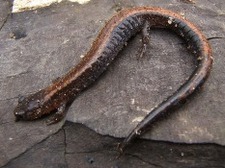
It’s been a few years since I’ve walked down near the floodplain in early spring and Sala_thturned over logs to look for Red-backed Salamanders (Plethodon cinereus). The other day I did just that, and was pleased to find one of these petite amphibians under nearly every log. Most were like this one on the right that I photographed – it’s easy to see how they got their name. But some were all gray, or “lead-backed.” Generally, the lead-backed forms are more common in lower elevations.  In the Midwest, lead-backs more common further south, being uncommon in Wisconsin and Minnesota.

Where they are found in the eastern U.S., red-backs are usually the most common salamander, and although extremely inconspicuous, their biomass may outstrip that of all the breeding birds and small mammals combined in a given forest. They belong to the family Plethodontidae, the lungless salamanders, which breathe through their skin. This intimate interface with the world around them makes them sensitive to environmental conditions. Plenthodontids make good indicators of woodland health.

Red-backed Salamanders are completely terrestrial, defending a small territory where they live under rocks or logs on the forest floor. Slowly prying up rotting limbs from the leaf litter, I uncovered earthworms and isopods, ants and beetles, and once a fortunately dull and sleepy hornet. Often I’d encounter one of those large, orange centipedes, but never under the same shelter as a Red-backed Salamander. Both of these organisms occupy a very similar niche, and salamanders respond aggressively towards centipedes. Since the centipedes are blind and don’t react to the visual threats presented by the amphibians, the salamanders bite them to drive them away.

Red-backed Salamanders must live in moist habitats, but will suffocate in water, which they do not require to reproduce – the larval stage is completed entirely in the egg. Tiny, fully formed salamanders emerge from the eggs, laid in clutches of fewer than 20, which are brooded by the females for six to nine weeks beginning in June. Hatchlings remain with the female for up to another two weeks. During this entire maternal period, females rarely eat, relying on their fat reserves until the hatchlings absorb their yolk sacs and begin to forage on their own. The hungry females can then spend the rest of summer building up their fat stores once more, this time to prepare for winter.

It is probably this requirement – the need to put on fat – that led female Red-backed Salamanders to develop a curious habit. They rip apart and inspect the feces of other salamanders. They don’t consume the excreta, just disassemble and examine it; researchers refer to it as “fecal squashing.” Because only females engage in fecal squashing, and since the turds contain chemicals that identify the gender and even the individual that produced them, it was assumed that this behavior somehow helped females assess the diet, and therefore the quality of the territory, of potential mates. It has come to pass (okay, I couldn’t resist) that the females do use stool squashing to evaluate prey availability in a territory, apparently in order to meet their own higher energy demands; experimental females fed low quality diets did more fecal squashing than their well-fed sisters. Males don’t let this tendency go to waste (sorry), they produce more poop when they sense females nearby, so as to increase the chance of encountering more females in their territories.

Carefully, I replaced the refugia I had disturbed, stood back, and looked out over the quiet forest. Tall trees, no understory, thick layer of fallen brown leaves interrupted by decaying limbs and branches. No sign of the small dramas and full lives taking place just above the soil.

Filed in Natural history

A friend sent me this article regarding a recent, as yet unpublished, study that found traces of DDT and similar organochlorines in North American non-migratory songbirds. This is surprising on two levels. The first is pretty obvious: DDT has been banned in the U.S. for over 30 years.

Study author R. Given Harper of Illinois Wesleyan University expected to find higher levels of pesticides in migratory songbirds, which winter in Latin America, where pesticides that are banned or restricted in the U.S. are still being used. Thus the other surprise was that the resident birds had two to ten times higher levels of DDT than did the migratory birds, and 17 types of organochlorines were found in resident birds versus only one to five types in the migratory birds.

This certainly seems counterintuitive. Where is the DDT coming from? But this excerpt from The Birder’s Handbook (Ehrlich, Dobkin, Wheye, 1988) may hint at an answer:

“…DDT has been shown to be present as a contaminant in the widely used toxin dicofol (a key ingredient in, among others, the pesticide Kelthane). Dicofol is a chemical formed by adding single oxygen atoms to DDT molecules. Unhappily, not all the DDT gets oxygenated, so that sometimes dicofol is contaminated with as much as 15 percent DDT. Overall, the 2.5 million pounds of dicofol used annually in pesticides contain about 250 thousand pounds of DDT.”

More information on the impact of pesticides on birds, including those compounds still used commonly in the U.S.:

UPDATE APR 30: Lake Apopka, Florida’s third largest lake, is an unfortunate poster child for the long lasting effects of pesticide contamination. The lake is in an agricultural setting, and restoration efforts included flooding surrounding farms to restore marshes. Hundreds of birds began to die as pesticides (mainly dieldrin, DDT and toxaphene) in the soils were reintroduced into the food chain (there was a big problem with alligators as well).

It takes a big dose of these pesticides to kill bird outright. Imagine what the sub-lethal effects of such massive contamination might be! Apparently little or nothing has been done to study such chemically-induced impairments such as behavioral changes. But the last few years eggs have been tested for contaminent levels. Over the last three years, 30% of bird eggs had DDT related contamination, despite remediation efforts.

You can read more about Lake Apopka at the Friends of Lake Apopka web site.

Filed in Environmental issues

tribute

Yesterday I went to the funeral of the mother of a friend.  I never met his mom, Joann, but funerals are for the living, and this man has done so much for me.  Joann had Alzheimer’s disease, which also claimed my mother’s life five years ago.  There are few more gut-wrenching things to go through than to watch a vibrant mind deteriorate.  My friend read letters written by family and friends who recalled events in his mother’s life.  One letter was from a relative who was cared for as a child for a time by Joann, who was a nurse.  Apparently Joann thought the relative had been poorly diagnosed, and felt the child had worms, and treated her for them.  My friend read, "Sure enough, a few days later I passed a big…"  My friend paused abruptly and said, "I think I’ll just skip over the next part."  Everyone had a big laugh.  That was certainly one of the most unique moments I can recall every at a funeral!

Anyway, here’s to Joann, and my mom Helen, both of whom are missed every day. As I do several times a year, I will today make a contribution to the Alzheimer’s Association.  If you know anybody who has suffered from this devastating disease, make a donation too.

Filed in Me

kudos to me

I tend to be publicly modest about my work; this tends to be detrimental, as I my position is funded entirely by soft money and it would probably be helpful if I blew my own horn more often.  I suppose I often have doubts about the worthiness of my work, in part due to the sometimes lukewarm and anemic institutional acknowledgement I receive (or don’t). So I feel a little weird about posting the following e-mail I received recently, from a person I’ve never met who reads my regular updates to a local birding listserv.  This is something I would print out and keep in a personal journal, and since personal journaling is one of the roles of this blog, I feel like it’s okay, so I’ll have it to refer to next time I lament the lack of nurturing and support for scientists.

I am in continued state of awe whenever I read your postings. Your skill, your knowledge, your willingnessto share, and above all your passion that has driven you to all of this over many, many years is so very much appreciated by someone who wishes I had taken a road more similar to yours.  Please know this – that you guide even those who are not with you on the path.  You shine a light that I am able to, at least, carry within.

As often as my energy level and providence allow, I try to make my updates to the local lists more interesting and readable than laundry lists of newly arrived migrants and banding totals. I get nice, modest applause e-mails occasionally, which are greatly appreciated.  This one is perhaps more effusive than the post that prompted it deserved, but knowing somebody is actually paying attention to what I write, and that I can bring some measure of inspiration to a stranger, well, it just feels great.

I thank you, blog reader, for tolerating this personal indulgence. Now back to regularly scheduled programming.

Filed in Me