

In previous posts (Introduction, Cowbird 101, Response to Cowbird 101 comments; see also comments sections) I’ve tried to give an overview of cowbird ecology and dispel some common misconceptions on the level of threat that cowbirds pose to most songbirds. Some people have taken that to mean that I don’t think cowbirds pose a threat to birds with small populations or restricted ranges, like Kirtland’s Warbler, or that I am perhaps proposing that reducing or eliminating cowbird control would not lead to fewer of these endangered species.
Hold on, let me finish. And remember 1) I don’t work with Kirtland’s Warblers, and am relying on available published research and private comments from sources that do work with them, and 2) in doing so I’m trying to show that there is another side to this story. That feelings have already run high in my e-mail and comments offer an example, I think, of how emotionally charged this issue is, and how difficult it is for some to change their minds about cowbirds.
~~~~~~
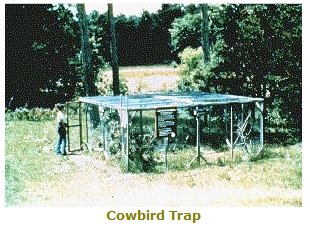 Trapping and killing cowbirds has been used as a cornerstone of management with several endangered species: Southwestern Willow Flycatcher (Empidonax traillii extimus), Least Bell’s Vireo (Vireo bellii pusillus), Black-capped Vireo (Vireo atricapillus), and Kirtland’s Warbler (Dendroica kirtlandii). The usual method is to lure cowbirds into large, screened traps with the use of decoys (live cowbirds kept in the trap). Once inside the trap, the cowbirds do not know how to escape. Cowbirds are removed and killed, usually once a day.
An unfortunate side-effect of cowbird trapping is the number of non-target species which are trapped. These birds are released (although some die in the traps), but because the traps are only emptied once a day, they may have been away from their own nests long enough to cause failure. In the cowbird traps in Kirtland’s Warblers areas alone during the 2001-2003 seasons, 1,826 birds of 29 non-target species were trapped, or over 12% of the total number of birds captured in the traps.
Cowbird control has been credited with saving some rare bird species. But is it really the cure-all that the public thinks it is?
Experts maintain that trapping cowbirds is a stop-gap measure, and should only be used to help boost or stabilize populations of rare birds. There are several important reasons why trapping cowbirds as a long-term management tool is not a great idea:
It prevents host species from developing defenses against parasitism.
The defensive behaviors of “rejecter” host species, outlined in a previous post, evolved due to selective pressure. Removing or relaxing that pressure — by trapping cowbirds and not exposing host species to nest parasitism — impacts the development of defensive behavior in these hosts.
It is not true that some species are always “acceptors.” For example, outside of the range of cowbirds in northern Manitoba, American Robins always accepted cowbird eggs experimentally placed in their nests. In southern Manitoba, where cowbirds are found, robins only accepted the eggs about one-third of the time.
Nor is it true that defensive behavior does not evolve quickly. In fact, once rejecter behavior appears in a host population, it rapidly spreads and becomes fixed. However, defenses only evolve and spread when the rate of nest parasitism remains high. (If you are skeptical that evolution can occur quickly, get a copy of the November 2005 special evolution issue of Natural History Magazine, and read the article “Evolution in Action”.) It is the opinion of some leading cowbird researchers that we are at a point where at least some cowbird control programs should be scaled back to determine whether hosts can defend themselves against parasitism.
Evolution works to thwart the usefulness of cowbird trapping in another way. Trapping targets unwary birds, and long-term trapping may end up producing trap-resistant populations of cowbirds.
It shifts attention and resources from real problems and solutions.
Trapping cowbirds is a relatively easy, low-tech management tool that requires less effort and expense than doing what really needs to be done to save endangered species: acquiring and restoring habitat. Habitat loss and degradation is the biggest threat to biodiversity. Habitat loss is the primary reason for the decline of all the bird species mentioned in which cowbird control is used for management. While short-term cowbird control helps increase rare host populations, it is effective only if there is enough suitable habitat available to support the surplus birds so that they can disperse and colonize historical areas.
More research is needed in determining and managing other population-limiting factors, and some of it is likely not being done, with funding being directed instead at cowbird control. For example, we know that the location and availability of feeding areas strongly influences cowbird numbers and distribution, yet there is insufficient data on exactly how landscape-level habitat management can reduce nest parasitism. Specific impacts of cowbird control on parasitism levels are under-studied. In Texas, for instance, cowbird trapping is suspected to have actually increased parasitism by attracting cowbirds to local populations of Black-capped Vireos.
It does not contribute to the objective of self-sustaining host populations.
The goal of endangered species recovery is self-sustaining populations. Cowbird trapping plans for endangered species generally do not have pre-determined criteria which would reduce or end the trapping. The dependence of host species on human intervention, by means of cowbird control, is thus open-ended. Endangered species management programs without exit strategies that will result in self-sustaining populations are exactly the type of policies that opponents of the Endangered Species Act can cite as failures. (That these opponents are wrong-headed is beside the point — they wield considerable legislative influence.)
When the number of dead cowbirds stands in for measures of real progress in endangered species recovery, we are failing in our obligation to protect rare birds.
Next, Kirtland’s Warblers and cowbirds. Is cowbird control really the reason warbler populations rebounded? Is it time to see if the warblers can make it on their own?



 Oliver Sacks, a neurologist, has written some fantastic books. Most notable (my favorites) are his compelling accounts of people with unusual neurological disorders:


